
Roadmap Governance Model
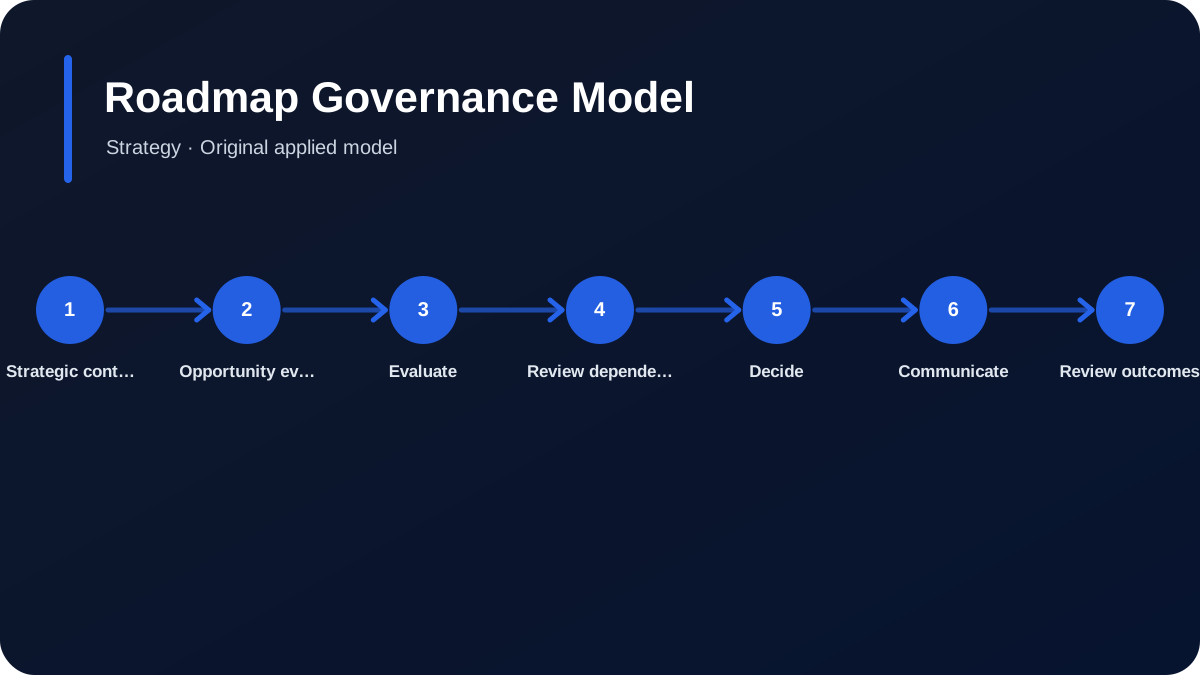
A governance model connecting strategic context, opportunity evidence, trade-offs, dependencies, risks, roadmap decisions, and outcome reviews.
Use it when: Multiple stakeholders compete for roadmap capacity.
Primary output: Opportunity register
Core principle: Frameworks support judgment; they do not replace evidence or accountability.
Why it exists
The problem it solves
Roadmaps become unstable feature lists when decision criteria, evidence, ownership, review cadence, and de-prioritization are unclear.
Ownership and attribution
Original applied model
Developed from recurring product-leadership practices and portfolio experience.
Use guidance
When to use it
- Multiple stakeholders compete for roadmap capacity.
- Priorities change without transparent reasoning.
- Dependencies and risks repeatedly disrupt commitments.
- Teams need a disciplined way to stop or defer work.
Context matters
When not to use it
- A small team has one clear objective and minimal dependencies.
- Governance is being used to centralize every minor product decision.
- The organization is unwilling to expose trade-offs.
Method
Inputs and process
The framework is designed to produce decisions and learning, not simply artifacts.
- 01
Strategic context
Confirm product missions, outcomes, constraints, and investment themes.
- 02
Opportunity evidence
Capture customer, market, product, commercial, and technical evidence.
- 03
Evaluate
Compare value, strategic fit, confidence, feasibility, risk, and platform leverage.
- 04
Review dependencies
Expose sequencing, architecture, data, organizational, and operational constraints.
- 05
Decide
Prioritize, defer, reject, stop, or request more evidence.
- 06
Communicate
Document rationale, assumptions, impacts, and what is not being pursued.
- 07
Review outcomes
Compare results with intent and return learning to the roadmap.
Decision quality
Key decision points
Is the opportunity strategically relevant?
Is evidence sufficient for the size of investment?
What is displaced by this choice?
What dependencies or risks change sequencing?
What evidence would cause the decision to change?
Outputs
What it produces
- Opportunity register
- Evidence score
- Prioritized roadmap
- Decision log
- Dependency map
- Not-now list
- Outcome review
Success
How it is measured
- Decision turnaround
- Roadmap stability
- Evidence coverage
- Dependency-related delay
- Stakeholder alignment
- Outcome achievement
- Stopped-work value
Skills
What it demonstrates
Portfolio application
How I apply it
I use roadmap governance to align engineering, UX, sales, support, and business stakeholders while making trade-offs and evidence visible.
Common pitfalls
How the framework is misused
- Treating scores as automatic decisions.
- Overweighting the loudest stakeholder.
- Hiding the cost of displaced work.
- Failing to revisit assumptions.
- Maintaining a roadmap with no outcome review.
Interview preparation
Discussion prompts
- How do you handle competing roadmap requests?
- How do you communicate a no or not-now decision?
- When should a roadmap commitment change?
- What makes governance useful rather than bureaucratic?
References
Attribution and sources
This framework is presented as an original or adapted portfolio model. Any future external influences will be documented here.