Product Discovery Framework
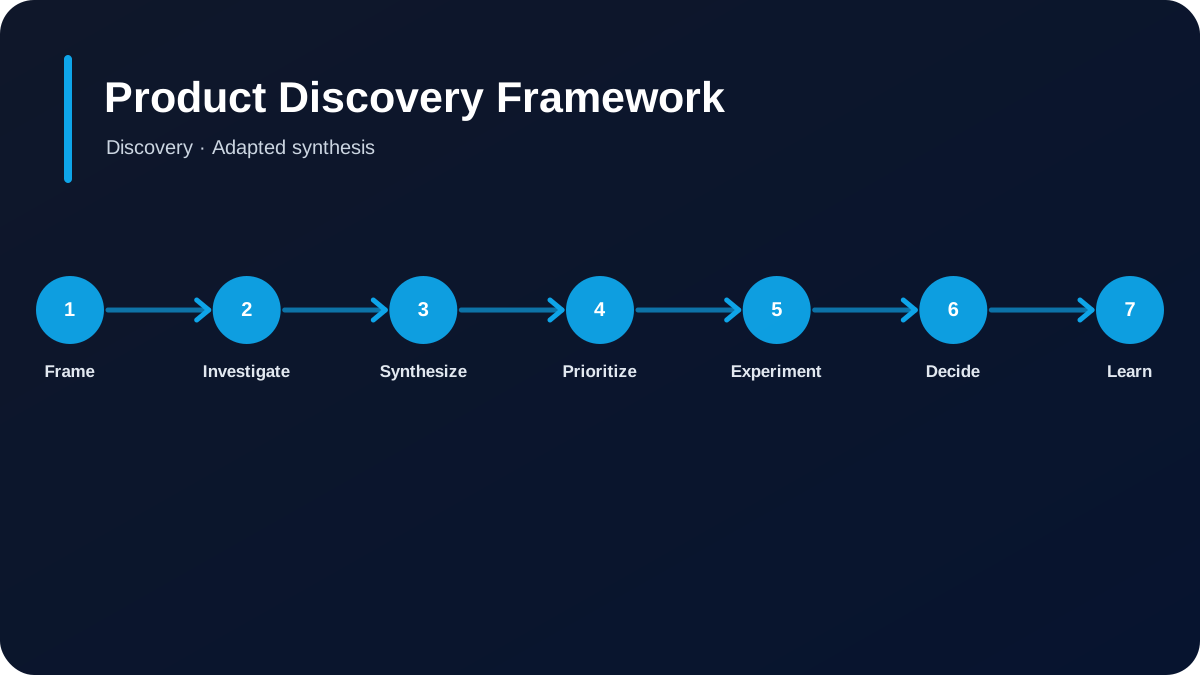
An evidence-driven cycle for framing uncertainty, investigating needs, synthesizing opportunities, experimenting, deciding, and learning.
Use it when: The problem, user, value, or solution is uncertain.
Primary output: Discovery brief
Core principle: Frameworks support judgment; they do not replace evidence or accountability.
Why it exists
The problem it solves
Discovery activities can produce research outputs without reducing the uncertainty behind a product decision.
Ownership and attribution
Adapted synthesis
Synthesized and adapted from established product practices for enterprise and AI application.
Use guidance
When to use it
- The problem, user, value, or solution is uncertain.
- A proposed investment is expensive or difficult to reverse.
- Teams have opinions but insufficient evidence.
- The organization needs continuous discovery alongside delivery.
Context matters
When not to use it
- The issue is a known defect with a clear correction.
- A mandatory change has no meaningful product choice.
- Research would not influence the decision.
Method
Inputs and process
The framework is designed to produce decisions and learning, not simply artifacts.
- 01
Frame
Define the decision, uncertainty, assumptions, users, and intended outcome.
- 02
Investigate
Collect qualitative, quantitative, commercial, technical, and operational evidence.
- 03
Synthesize
Identify patterns, opportunities, tensions, and evidence gaps.
- 04
Prioritize
Select the most important opportunities or assumptions to test.
- 05
Experiment
Choose the fastest responsible method to create decision-quality evidence.
- 06
Decide
Proceed, revise, pause, reject, or continue learning.
- 07
Learn
Document what changed and return insight to strategy, roadmap, and delivery.
Decision quality
Key decision points
What decision must discovery support?
Which assumption creates the greatest risk?
What evidence is sufficient for this investment?
Which experiment is fastest without being misleading?
What changed because of the evidence?
Outputs
What it produces
- Discovery brief
- Research synthesis
- Opportunity map
- Assumption register
- Experiment plan
- Decision record
- Updated roadmap or requirements
Success
How it is measured
- Decision confidence
- Time to evidence
- Assumptions tested
- Research-to-decision conversion
- Avoided delivery waste
- Post-launch validation accuracy
Skills
What it demonstrates
Portfolio application
How I apply it
I use discovery to clarify enterprise workflows, stakeholder needs, exception paths, reporting requirements, and AI opportunity readiness before converting evidence into product requirements.
Common pitfalls
How the framework is misused
- Research without a decision.
- Interviewing only internal stakeholders.
- Validating a preferred solution rather than testing assumptions.
- Running experiments with unrealistic users or context.
- Failing to document disconfirming evidence.
Interview preparation
Discussion prompts
- How do you decide what to discover?
- How do you know when evidence is sufficient?
- Tell me about evidence that changed your direction.
- How do discovery and delivery operate together?
References
Attribution and sources
This framework is presented as an original or adapted portfolio model. Any future external influences will be documented here.