
Product Health Framework
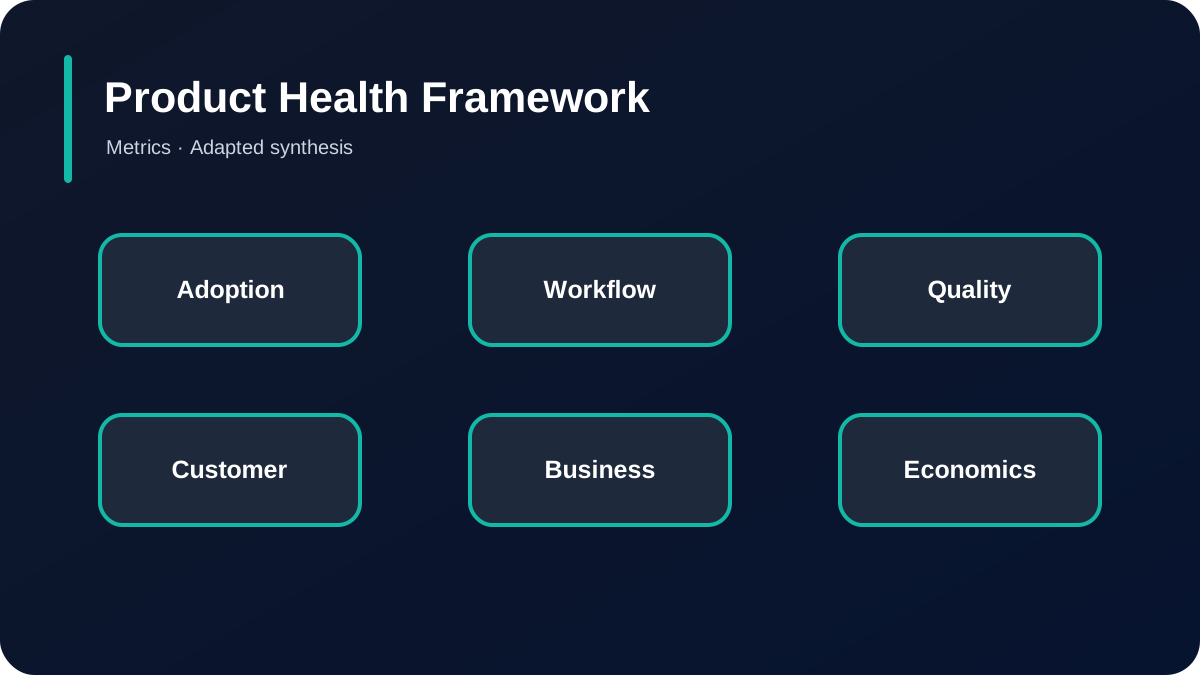
A balanced product-health model covering reach, activation, engagement, workflow success, quality, customer value, business value, and product economics.
Use it when: A product needs an executive health view.
Primary output: Product-health scorecard
Core principle: Frameworks support judgment; they do not replace evidence or accountability.
Why it exists
The problem it solves
Teams often optimize isolated usage metrics while missing workflow failure, reliability, support burden, business value, and AI-quality signals.
Ownership and attribution
Adapted synthesis
Synthesized and adapted from established product practices for enterprise and AI application.
Use guidance
When to use it
- A product needs an executive health view.
- Teams disagree about which metrics matter.
- Adoption is visible but value or quality is unclear.
- An AI-enabled workflow needs product and model signals together.
Context matters
When not to use it
- A pre-discovery concept has no product behavior to measure.
- The dashboard is being created without decision owners.
- Metrics cannot be connected to actions or thresholds.
Method
Inputs and process
The framework is designed to produce decisions and learning, not simply artifacts.
- 01
Define value
State the customer and business value the product should create.
- 02
Map lifecycle
Identify reach, activation, engagement, retention, and expansion behavior.
- 03
Map workflows
Define successful completion, abandonment, errors, exceptions, and correction.
- 04
Add quality
Include reliability, latency, defects, support, and incident measures.
- 05
Add economics
Include revenue, margin, processing cost, implementation effort, and support burden.
- 06
Set thresholds
Define target, warning, and intervention levels with owners.
- 07
Review and act
Use a regular cadence to diagnose causes, decide actions, and track recovery.
Decision quality
Key decision points
Does the metric represent value or merely activity?
Is it leading, lagging, or a guardrail?
Who can influence it?
What action occurs when it crosses a threshold?
Which segments conceal important differences?
Outputs
What it produces
- Product-health scorecard
- Metric dictionary
- Instrumentation gaps
- Threshold and ownership matrix
- Health-review cadence
- Action log
Success
How it is measured
- Activation
- Time to value
- Meaningful engagement
- Retention
- Workflow completion
- Error and correction
- Reliability
- Support burden
- Revenue and cost
Skills
What it demonstrates
Portfolio application
How I apply it
I use product-health thinking to connect roadmap decisions with adoption, workflow performance, operational quality, customer evidence, and business value.
Common pitfalls
How the framework is misused
- Tracking activity without value.
- Creating dashboards without decisions.
- Using averages that hide segments.
- Ignoring operational cost and support burden.
- Changing metric definitions without governance.
Interview preparation
Discussion prompts
- How do you define product health?
- Which metrics would you use for an AI workflow?
- How do you prevent metric overload?
- How do thresholds change product decisions?
References
Attribution and sources
This framework is presented as an original or adapted portfolio model. Any future external influences will be documented here.