
Opportunity Solution Tree
A visual structure connecting a desired outcome to customer opportunities, possible solutions, and experiments.
Use it when: A team needs to align around an outcome.
Primary output: Outcome statement
Core principle: Frameworks support judgment; they do not replace evidence or accountability.
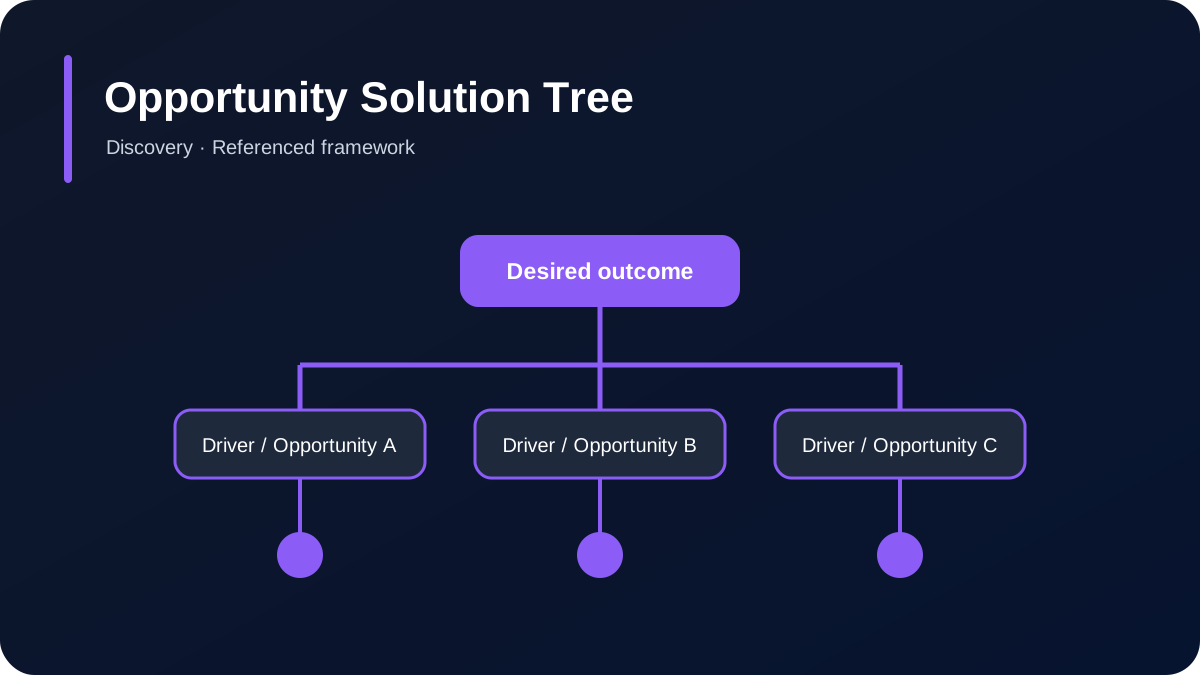
Why it exists
The problem it solves
Teams jump from a business outcome to one favored solution without exploring the opportunity space or alternative approaches.
Ownership and attribution
Referenced framework
An established framework presented with attribution, application guidance, and portfolio-specific extensions.
Use guidance
When to use it
- A team needs to align around an outcome.
- Customer evidence reveals multiple needs or pain points.
- Several solution options are being considered.
- Continuous discovery needs a shared visual map.
Context matters
When not to use it
- As a substitute for direct customer evidence.
- When the desired outcome is undefined.
- When every branch is treated as a committed roadmap item.
Method
Inputs and process
The framework is designed to produce decisions and learning, not simply artifacts.
- 01
Set outcome
Choose a measurable outcome the product team can influence.
- 02
Map opportunities
Organize customer needs, pain points, and desires from evidence.
- 03
Generate solutions
Explore multiple ways to address selected opportunities.
- 04
Identify assumptions
Expose desirability, usability, feasibility, viability, and ethical assumptions.
- 05
Design experiments
Choose tests that create decision-quality evidence.
- 06
Update continuously
Revise the tree as evidence and decisions evolve.
Decision quality
Key decision points
Is the outcome measurable and influenceable?
Is each opportunity grounded in evidence?
Have multiple solutions been explored?
Which assumption is most important and uncertain?
What evidence changes the tree?
Outputs
What it produces
- Outcome statement
- Opportunity map
- Solution alternatives
- Assumption map
- Experiment backlog
- Discovery decision record
Success
How it is measured
- Opportunity evidence coverage
- Solution alternatives considered
- Assumptions tested
- Experiment cycle time
- Outcome movement
Skills
What it demonstrates
Portfolio application
How I apply it
I adapt the tree for enterprise and AI products by adding assumption risk, evidence status, operational constraints, and human-oversight considerations.
Common pitfalls
How the framework is misused
- Inventing opportunities in a workshop.
- Turning the tree into a feature backlog.
- Mapping too much without prioritizing.
- Treating branches as mutually exclusive facts.
- Failing to update the tree.
Interview preparation
Discussion prompts
- How do you distinguish an opportunity from a solution?
- How do you keep the tree evidence-based?
- What enterprise constraints would you add?
- How does the tree change roadmap conversations?
References
Attribution and sources
Established framework developed by Teresa Torres. This portfolio page explains my application and extensions.