Product Operating System
An end-to-end operating model connecting customer evidence, strategy, delivery, product health, and continuous learning.
Use it when: Multiple teams need one product-delivery language.
Primary output: Opportunity brief
Core principle: Frameworks support judgment; they do not replace evidence or accountability.
Why it exists
The problem it solves
Product teams often have strong individual practices but lack a shared operating model connecting discovery, decisions, delivery, launch, measurement, and roadmap learning.
Ownership and attribution
Original framework
Developed from recurring product-leadership practices and portfolio experience.
Use guidance
When to use it
- Multiple teams need one product-delivery language.
- Roadmap decisions are disconnected from evidence.
- Discovery and delivery operate as separate systems.
- Post-launch learning is not consistently returned to the roadmap.
Context matters
When not to use it
- A small, time-boxed experiment needs only a lightweight plan.
- The team is looking for a rigid stage-gate process with no iteration.
- Roles and decision ownership have not been agreed.
Method
Inputs and process
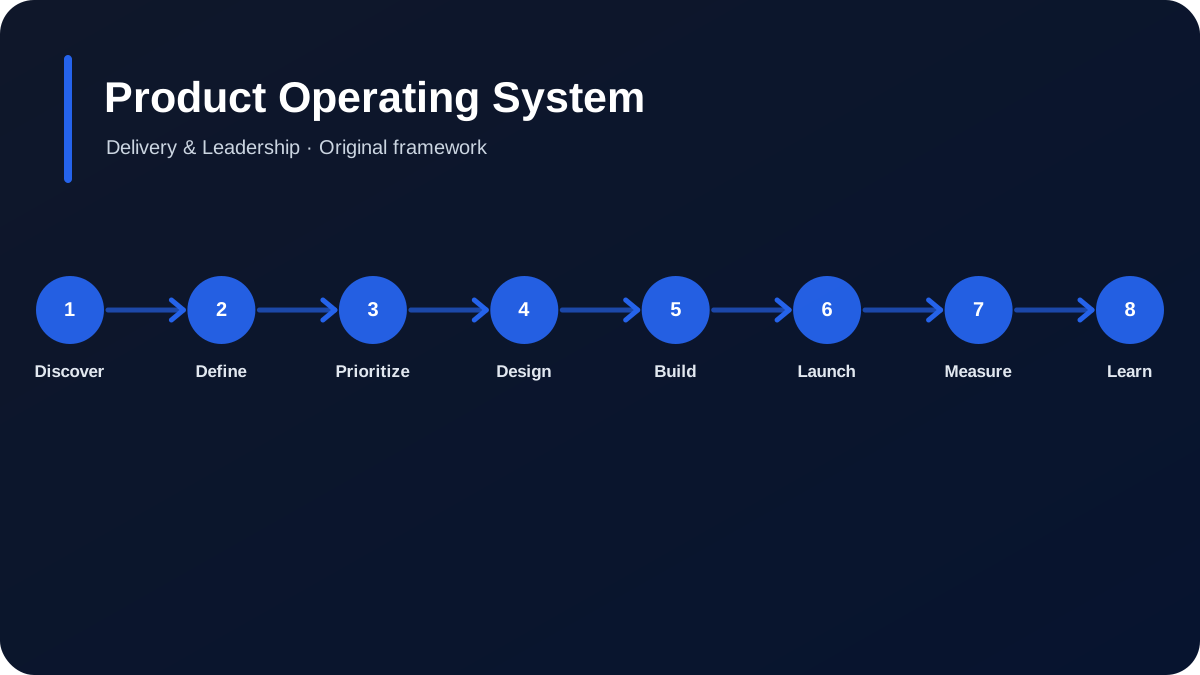
The framework is designed to produce decisions and learning, not simply artifacts.
- 01
Discover
Understand users, workflows, evidence, constraints, and unresolved uncertainty.
- 02
Define
Frame the problem, intended outcome, scope, assumptions, and success measures.
- 03
Prioritize
Compare opportunities using value, evidence, feasibility, risk, and strategic fit.
- 04
Design
Shape the workflow, experience, requirements, analytics, and operating model.
- 05
Build
Deliver incrementally with clear acceptance criteria, dependencies, and quality controls.
- 06
Launch
Confirm readiness across product, technology, support, operations, and communications.
- 07
Measure
Evaluate adoption, workflow success, quality, reliability, economics, and business outcomes.
- 08
Learn
Turn evidence into product improvements, roadmap changes, or retirement decisions.
Decision quality
Key decision points
Is the problem important and sufficiently evidenced?
Is the opportunity aligned with product strategy?
Are scope, success measures, and responsibilities clear?
Is the release operationally ready?
Should the product be scaled, improved, constrained, or stopped?
Outputs
What it produces
- Opportunity brief
- Prioritized roadmap decision
- PRD and delivery artifacts
- Release-readiness decision
- Product-health review
- Decision and learning log
Success
How it is measured
- Decision cycle time
- Roadmap alignment
- Requirement clarity
- Release predictability
- Time to first value
- Workflow success
- Learning-to-roadmap conversion
Skills
What it demonstrates
Portfolio application
How I apply it
I use this operating model to connect product missions, roadmap governance, requirements, delivery, product-health measurement, and cross-functional learning in enterprise SaaS environments.
Common pitfalls
How the framework is misused
- Treating the model as a linear waterfall.
- Creating artifacts without explicit decisions.
- Skipping post-launch measurement.
- Making every stage equally heavy regardless of risk.
- Using governance as approval bureaucracy rather than decision clarity.
Interview preparation
Discussion prompts
- How do you move from an ambiguous opportunity to an executable roadmap decision?
- Where have you adapted this operating model to fit a team’s maturity?
- Which decision gate has prevented the most waste?
- How do post-launch findings change your roadmap?
References
Attribution and sources
This framework is presented as an original or adapted portfolio model. Any future external influences will be documented here.