
AI Product Lifecycle
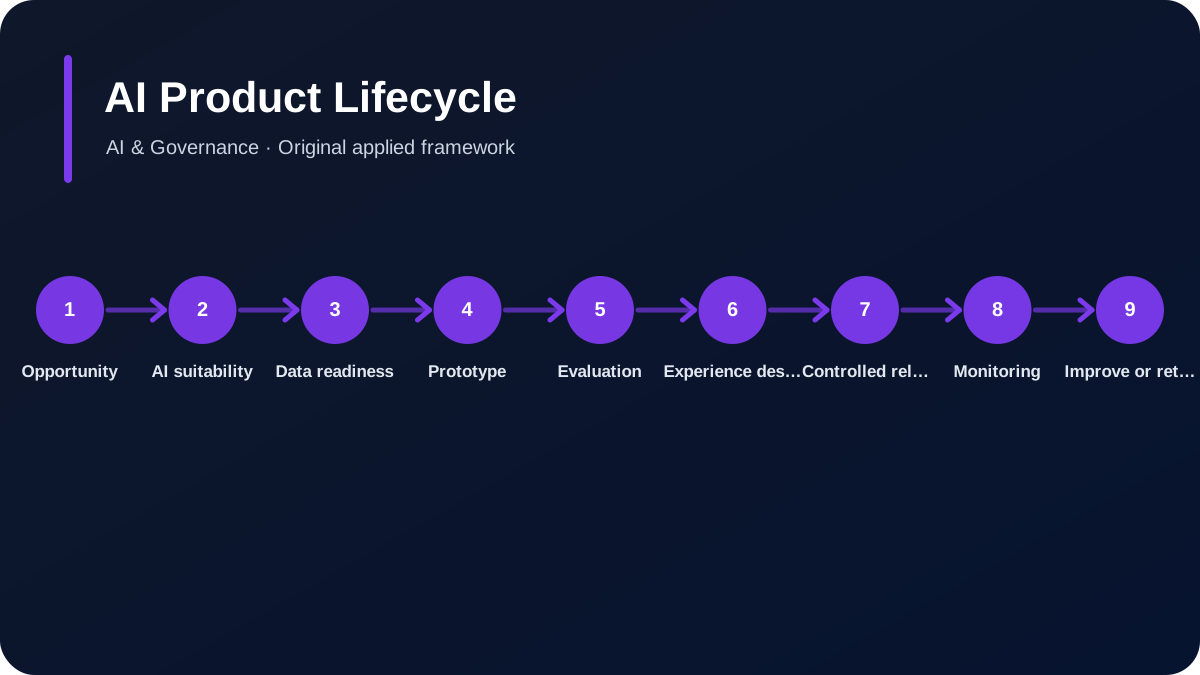
A stage-and-gate lifecycle for moving an AI opportunity from workflow discovery to controlled production monitoring.
Use it when: A team is evaluating an AI-enabled workflow.
Primary output: AI opportunity assessment
Core principle: Frameworks support judgment; they do not replace evidence or accountability.
Why it exists
The problem it solves
AI initiatives frequently begin with model capability rather than a validated workflow problem, creating weak adoption, unclear accountability, and production risk.
Ownership and attribution
Original applied framework
Developed from recurring product-leadership practices and portfolio experience.
Use guidance
When to use it
- A team is evaluating an AI-enabled workflow.
- Model output influences user decisions or consequential actions.
- Data readiness and evaluation criteria are uncertain.
- The product requires ongoing quality, latency, cost, and risk monitoring.
Context matters
When not to use it
- A deterministic rule solves the problem more reliably.
- There is no meaningful workflow problem or user need.
- Data cannot be lawfully or responsibly used.
- The organization cannot support monitoring or human oversight.
Method
Inputs and process
The framework is designed to produce decisions and learning, not simply artifacts.
- 01
Opportunity
Define the workflow problem, value hypothesis, affected users, and alternatives.
- 02
AI suitability
Determine whether AI is appropriate compared with deterministic or manual approaches.
- 03
Data readiness
Assess availability, quality, privacy, representativeness, and access.
- 04
Prototype
Build the smallest testable capability and workflow integration.
- 05
Evaluation
Measure task quality, failure modes, fairness, robustness, latency, and cost.
- 06
Experience design
Design confidence, evidence, review, correction, escalation, and feedback.
- 07
Controlled release
Launch to a bounded audience with clear safeguards and support readiness.
- 08
Monitoring
Track quality, workflow success, adoption, drift, incidents, economics, and feedback.
- 09
Improve or retire
Scale, constrain, redesign, or retire based on production evidence.
Decision quality
Key decision points
Is AI materially better than available alternatives?
Is the data fit for the intended context?
Are evaluation thresholds tied to workflow consequences?
Is human oversight appropriate and usable?
Are production reliability, cost, and monitoring acceptable?
Outputs
What it produces
- AI opportunity assessment
- Data-readiness decision
- Evaluation plan
- Human-oversight design
- Controlled-release plan
- Production monitoring dashboard
Success
How it is measured
- Workflow completion
- User acceptance and correction
- Escalation rate
- Quality by segment
- Latency
- Cost per workflow
- Incident rate
- Adoption and repeat use
Skills
What it demonstrates
Portfolio application
How I apply it
I apply this lifecycle when assessing enterprise AI opportunities, defining human-reviewed workflows, and translating quality, privacy, latency, cost, and monitoring needs into product requirements.
Common pitfalls
How the framework is misused
- Starting with a model instead of a workflow.
- Using one accuracy score as the definition of success.
- Leaving human review undefined.
- Ignoring production economics.
- Treating release as the end of evaluation.
Interview preparation
Discussion prompts
- How do you decide whether AI is appropriate?
- How do you turn model evaluation into product requirements?
- Where should human review occur?
- What evidence would cause you to retire an AI capability?
References
Attribution and sources
This framework is presented as an original or adapted portfolio model. Any future external influences will be documented here.