
Decision Matrix
A transparent prioritization aid comparing options across customer value, strategic fit, evidence, business value, feasibility, readiness, and risk.
Use it when: Several credible options compete for investment.
Primary output: Decision matrix
Core principle: Frameworks support judgment; they do not replace evidence or accountability.
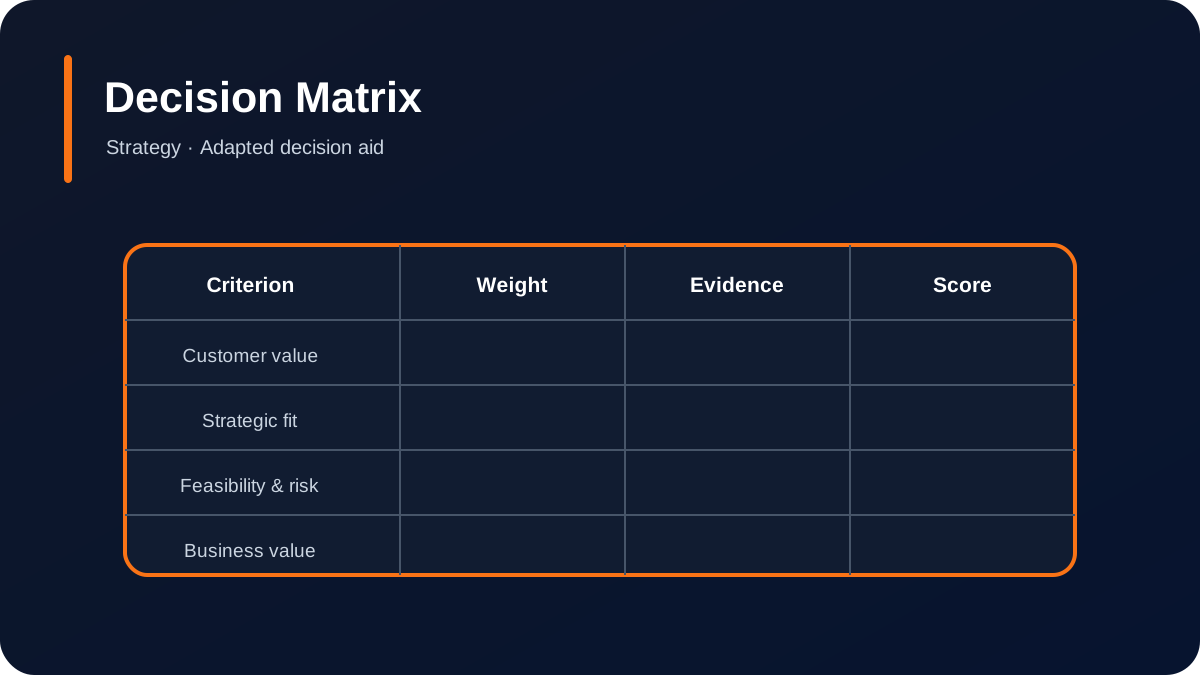
Why it exists
The problem it solves
Complex product decisions become dominated by intuition, hierarchy, or one-dimensional scoring without exposing assumptions and trade-offs.
Ownership and attribution
Adapted decision aid
Synthesized and adapted from established product practices for enterprise and AI application.
Use guidance
When to use it
- Several credible options compete for investment.
- Stakeholders use different decision criteria.
- The rationale must be documented and communicated.
- Evidence confidence differs across options.
Context matters
When not to use it
- The decision is mandatory or binary with no meaningful alternatives.
- Weights are chosen to manufacture a preferred answer.
- Scores are treated as objective truth.
Method
Inputs and process
The framework is designed to produce decisions and learning, not simply artifacts.
- 01
Frame decision
Define the choice, decision owner, deadline, and consequences.
- 02
Identify alternatives
Include realistic options such as defer, stop, or learn more.
- 03
Define criteria
Select a small set of independent, decision-relevant criteria.
- 04
Set weights
Make relative importance and rationale explicit.
- 05
Score with evidence
Record scores, confidence, sources, and disagreement.
- 06
Test sensitivity
Check whether reasonable weight or score changes alter the ranking.
- 07
Decide and document
Use the result as input to judgment and record the final rationale.
Decision quality
Key decision points
Are the options genuinely distinct?
Are criteria overlapping?
What evidence supports each score?
How sensitive is the ranking?
Why might judgment override the numeric result?
Outputs
What it produces
- Decision matrix
- Evidence notes
- Sensitivity analysis
- Decision record
- Follow-up evidence plan
Success
How it is measured
- Decision transparency
- Stakeholder understanding
- Decision turnaround
- Reversal due to hidden assumptions
- Evidence coverage
Skills
What it demonstrates
Portfolio application
How I apply it
I use decision matrices to structure roadmap and solution trade-offs while keeping confidence, risk, and qualitative judgment visible.
Common pitfalls
How the framework is misused
- False precision.
- Double-counting related criteria.
- Ignoring confidence.
- Choosing weights after seeing scores.
- Letting the matrix replace accountability.
Interview preparation
Discussion prompts
- When should a score not determine the decision?
- How do you choose weights?
- How do you expose confidence?
- What alternatives should always be considered?
References
Attribution and sources
This framework is presented as an original or adapted portfolio model. Any future external influences will be documented here.